
Wall types in London homes, and what they mean for a fixing
Plaster is a finish. The holding power of a screw lives in whatever is behind it. These bands describe backgrounds that turn up often in London. They are not a survey of your wall.
Published · Updated
Solid brick, with plaster
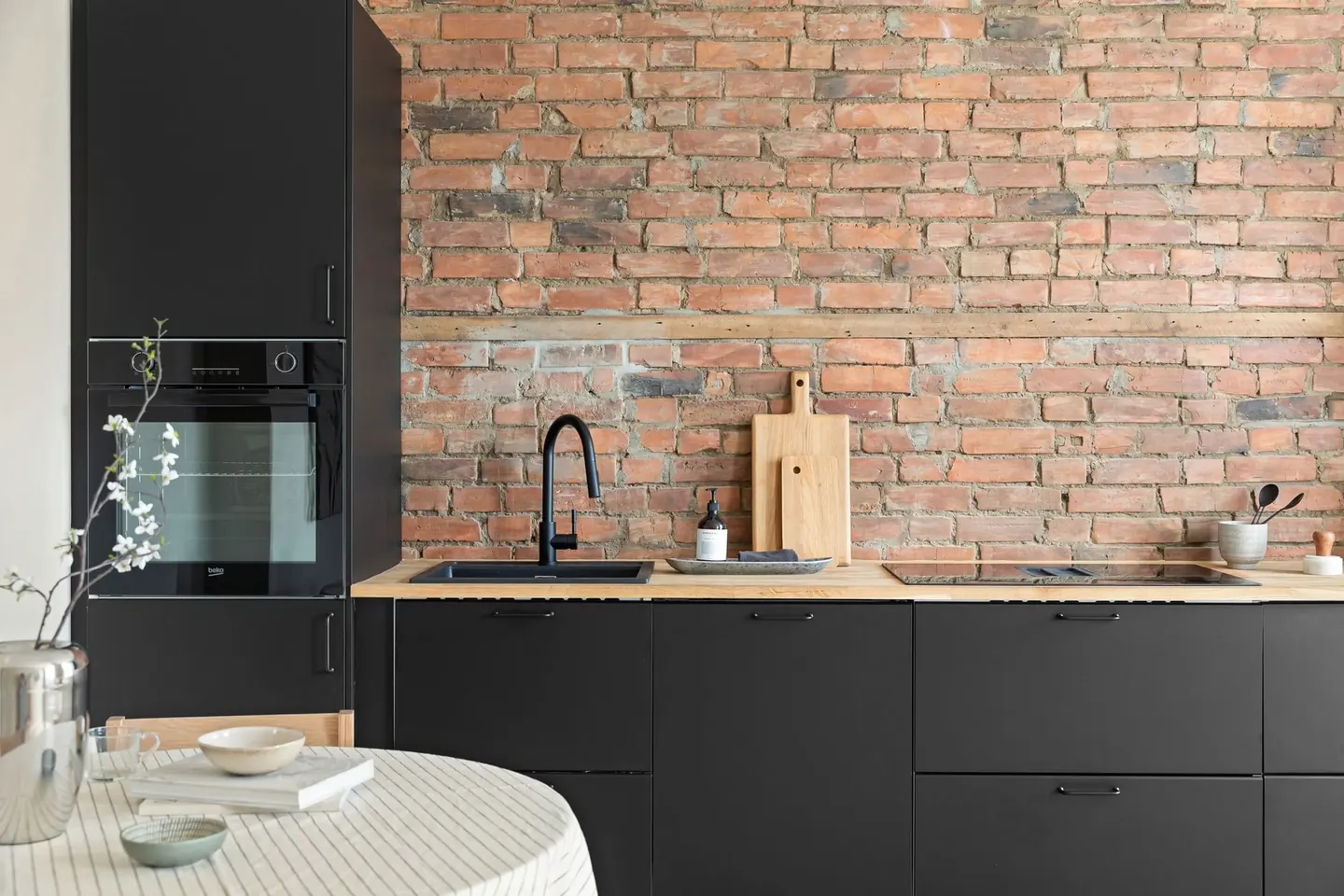
A large share of Victorian and Edwardian houses are brick. The inside face may be a sand-and-cement or lime plaster applied straight to that brick. Tapped with a knuckle, it tends to sound dull rather than hollow, though a thick plaster can blur the sound.
A masonry fixing is the usual family of plug for a solid background, and it has to reach the brick, not stop in the plaster. Plaster alone is a poor hold for a loaded cupboard. The drill, the plug and the screw still have to match each other and the load the leaflet states. This page does not give a diameter or a depth, because those belong to the fixing maker’s data and to the wall in front of you.
Lath and plaster
Many rooms that have never been fully replastered still have timber laths with plaster pushed between them. The surface can sound more lively, crack in a web, and move slightly under a firm press. A short plug in the plaster may meet a lath, a gap, or a brick further back.
Drilling here can blow the plaster off the laths over a wide patch. If the room is rented, listed, or simply old and intact, that risk is a reason to pause and ask the person responsible for the building before any hole is made. A fixing that needs to carry a wardrobe should reach a background that can take it, which may be masonry or a stud, not the lath itself.
Plasterboard on dabs
A common later lining is plasterboard stuck to masonry with dabs of adhesive. There is a void. A short fixing holds only the board, which is not a support for a wall cabinet or a tall restraint. A longer fixing may reach the brick if it is aimed at a dab or through the void into solid material, and it may also miss and spin in the gap.
Sound is a clue, not a proof. Hollow taps between dabs and a duller tap on a dab are typical, and they can be misleading next to a flue or a change of construction. When the load is more than a light frame, the person doing the work needs to know which background the screw will actually enter.
Stud partitions
Conversions, new internal walls and a lot of post-war flats use plasterboard on timber or metal studs. The void is real. A hollow-wall fixing is designed for board with space behind it. A screw into a timber stud, found and confirmed, is a different and often stiffer hold. Metal studs need the fitting the stud system allows.
Studs are commonly spaced at regular centres, but older alterations ignore the pattern. A magnet or a stud finder is a hint. The proof is the screw meeting solid material where you expected it. Do not assume a party wall between flats is a simple stud you may cut into.
Block and concrete
Some mansion blocks, ex-local authority flats and later houses have concrete frames, concrete panel walls, or lightweight block. The surface may still be plaster or board, so the face does not announce the structure. Concrete can be dense enough that an ordinary masonry bit makes little progress. That is information, not a reason to force a larger hole.
Fixings for concrete are a distinct range. The structural drawing, if the building has one, and the managing agent are better sources than a guess from the paint colour.
Cables, pipes and flues
In modern work, cables often run horizontally or vertically from a socket or a switch. Older houses are less predictable: lighting drops, abandoned points and pipes in boxing turn up in the middle of a wall. A radiator on the wall, or a bathroom the other side of it, is a reason to expect a pipe. A chimney breast may be brick at the edges and a flue, empty or lined, toward the middle. Do not treat the whole breast as solid fixing ground.
A pipe or cable detector is a check, not a certainty. If the route of a service is unknown and the fixing is not trivial, stop and find out. Nothing in this note is an instruction to drill.
Leases and shared walls
A great many London homes are leasehold. Leases often limit what may be fixed to, or cut into, the structure, and they distinguish the tenant’s interior from the landlord’s walls. Asking the freeholder or the managing agent, and reading the lease, is the ordinary step before a heavy fixing. This publication does not give legal advice and does not read leases.
Party walls between houses or flats are shared. Chasing them, or loading them, can be a matter for the neighbour and for the building, not only for the room you are furnishing.
Related reading: flat-pack checks, kitchen plans, and restraints after fitting.